बन्धकारणशैथिल्यात् प्रचारसंवेदनाच् च चित्तस्य परशरीरावेशः
bandhakāraṇaśaithilyāt pracārasaṃvedanāc ca cittasya paraśarīrāveśaḥ
bandha बन्ध – bondage, attachment
kāraṇa कारण- cause
shaithilyat शैथिल्यात् – relaxation, letting go, loosening
pracāra प्रचार – passages, means of going forth, moving through
samvedanat संवेदनाच् – by knowledge of; when you understand
cha च – and
chittasya चित्तस्य – the psyche; the mind; awareness; perception
para पर – higher, highest, supreme; other
sharira शरीर – body
aveshah आवेशः – entering into
When you understand the cause of your bondage, the ties that bind you loosen, your perception is free to roam, and your mind can enter other people’s bodies.
Or…
When you understand the cause of your bondage, the ties that bind you loosen. Consciousness is liberated and enters Oneness.
Patanjali continues to kid us, tempting us with yet another superpower, to enter parasharira, another double entendre, which can be understood as either “another body” or “the supreme body” (Oneness).
Once you give up the Freaky Friday idea of taking over someone else’s body and reset Oneness as your goal, the more interesting lesson in this sutra, is the cause of bondage. Patanjali has already made clear, in sutra 2.5, that the cause of bondage is ignorance, mistaking the temporary for the eternal, the impure for the pure, pain for pleasure, and the ego for the Self.
The cause of bondage is a topic that’s discussed at length in the Ashtavakra Gita:
You are the one witness of everything and are always completely free. The cause of your bondage is that you see the witness as something other than this.
Since you have been bitten by the black snake, the opinion about yourself that “I am the doer,” drink the antidote of faith in the fact that “I am not the doer,” and be happy.
Burn down the forest of ignorance with the fire of the understanding that “I am the one pure awareness,” and be happy and free from distress.
That in which all this appears is imagined like the snake in a rope; joy, the supreme joy of awareness is what you are, so be happy.
If one thinks of oneself as free, one is free, and if one thinks of oneself as bound, one is bound. Here this saying is true, “Thinking makes it so.”
Your real nature is as the one perfect, free, and actionless consciousness, the all-pervading witness — unattached to anything, desireless and at peace. It is from illusion that you seem to be involved in the endless cycle of birth and death.
Meditate on yourself as motionless awareness, free from any dualism, giving up the mistaken idea that you are just a derivative consciousness or anything external or internal.
You have long been trapped in the snare of identification with the body. Sever it with the knife of knowledge that “I am awareness,” and be happy.
You are really unbound and actionless, self-illuminating and spotless already. The cause of your bondage is that you are still resorting to stilling the mind.
* * *For me here is neither bondage nor liberation. The illusion has lost its basis and ceased. Truly all this exists in me, though ultimately it does not even exist in me.
Recognising that all this and my body too are nothing, while my true self is nothing but pure consciousness, what is there left for the imagination to work on now?
The body, heaven and hell, bondage and liberation, and fear too, all this is pure imagination. What is there left to do for me whose very nature is consciousness?
I do not even see dualism in a crowd of people, so what do I gain if it is replaced by a desert?
I am not the body, nor is the body mine. I am not a living being. I am consciousness. It was my thirst for living that was my bondage.
* * *
It is astonishing that a man who has reached the supreme nondual state and is intent on the benefits of liberation should still be subject to lust and in bondage to sexual activity.
It is astonishing that one already very debilitated, and knowing very well that its arousal is the enemy of knowledge, should still hanker after sensuality, even when approaching his last days.
It is astonishing that one who is unattached to the things of this world or the next, who discriminates between the permanent and the impermanent, and who longs for liberation, should still be afraid of liberation.
Whether feted or tormented, the wise man is always aware of his supreme self-nature and is neither pleased nor disappointed.
The great-souled person sees even his own body in action as if it were someone else’s, so how should he be disturbed by praise or blame?
Seeing this world as pure illusion, and devoid of any interest in it, how should the strong-minded person, feel fear, even at the approach of death?
* * *
Bondage is when the mind longs for something, grieves about something, rejects something, holds on to something, is pleased about something or displeased about something.
Liberation is when the mind does not long for anything, grieve about anything, reject anything, or hold on to anything, and is not pleased about anything or displeased about anything.
Bondage is when the mind is tangled in one of the senses, and liberation is when the mind is not tangled in any of the senses.
When there is no “me,” that is liberation, and when there is “me” there is bondage. Consider this carefully, and neither hold on to anything nor reject anything.
* * *
The essential nature of bondage is nothing other than desire, and its elimination is known as liberation. It is simply by not being attached to changing things that the everlasting joy of attainment is reached.
You are one, conscious and pure, while all this is inert non-being. Ignorance itself is nothing, so what is the point of wanting to understand?
Kingdoms, children, lovers, bodies, pleasures — these have all been lost to you life after life, attached to them though you were.
Enough of wealth, sensuality, and trying to save the world. The mind has never found satisfaction in these.
How many births have you not done hard and painful labour with body, mind, and speech. Now at last, stop!
* * *
Realizing my supreme self-nature in the supreme Person of the Witness, and the state of desirelessness in bondage or liberation, I feel no inclination for liberation.
The various states of one who is free of uncertainty within, and who outwardly wanders about as he pleases like an idiot, can only be known by someone in the same condition.
* * *
Liberation is distaste for the objects of the senses. Bondage is love of the senses. This is knowledge. Now do as you wish.
This awareness of the truth makes an eloquent, clever and energetic man dumb, stupid and lazy, so it is avoided by those whose aim is enjoyment.
You are not the body, nor is the body yours, nor are you the doer of actions or the reaper of their consequences. You are eternally pure consciousness, the witness, in need of nothing — so live happily.
Desire and anger are objects of the mind, but the mind is not yours, nor ever has been. You are choiceless awareness itself and unchanging — so live happily.
Recognizing oneself in all beings, and all beings in oneself, be happy, free from the sense of responsibility and free from preoccupation with “me.”
Your nature is the consciousness, in which the whole world wells up, like waves in the sea. That is what you are, without any doubt, so be free of disturbance.
Have faith, have faith. Don’t let yourself be deluded in this. You are yourself the Oneness, whose very nature is knowledge, and you are beyond natural causation.
The body invested with the senses stands still, and comes and goes. You yourself neither come nor go, so why bother about them?
Let the body last to the end of the Age, or let it come to an end right now. What have you gained or lost, who consist of pure consciousness?
Let the world wave rise or subside according to its own nature in you, the great ocean. It is no gain or loss to you.
You consist of pure consciousness, and the world is not separate from you. So who is to accept or reject it, and how, and why?
How can there be either birth, karma, or responsibility in that one unchanging, peaceful, unblemished, and infinite consciousness which is you?
Whatever you see, it is you alone manifest in it. How can bracelets, armlets, and anklets be different from the gold they are made of?
Giving up such distinctions as “He is what I am,” and “I am not that,” recognize that “Everything is myself,” and be without distinction and happy.
It is through your ignorance that all this exists. In reality you alone exist. Apart from you there is no one within the endless wheel of birth and death. Apart from you there is no one beyond the endless wheel of birth and death.
Knowing that all this is just an illusion, one becomes free of desire, pure receptivity, and at peace, as if nothing existed.
Only one thing has existed, exists and will exist in the ocean of being. You have no bondage or liberation. Live happily and fulfilled.
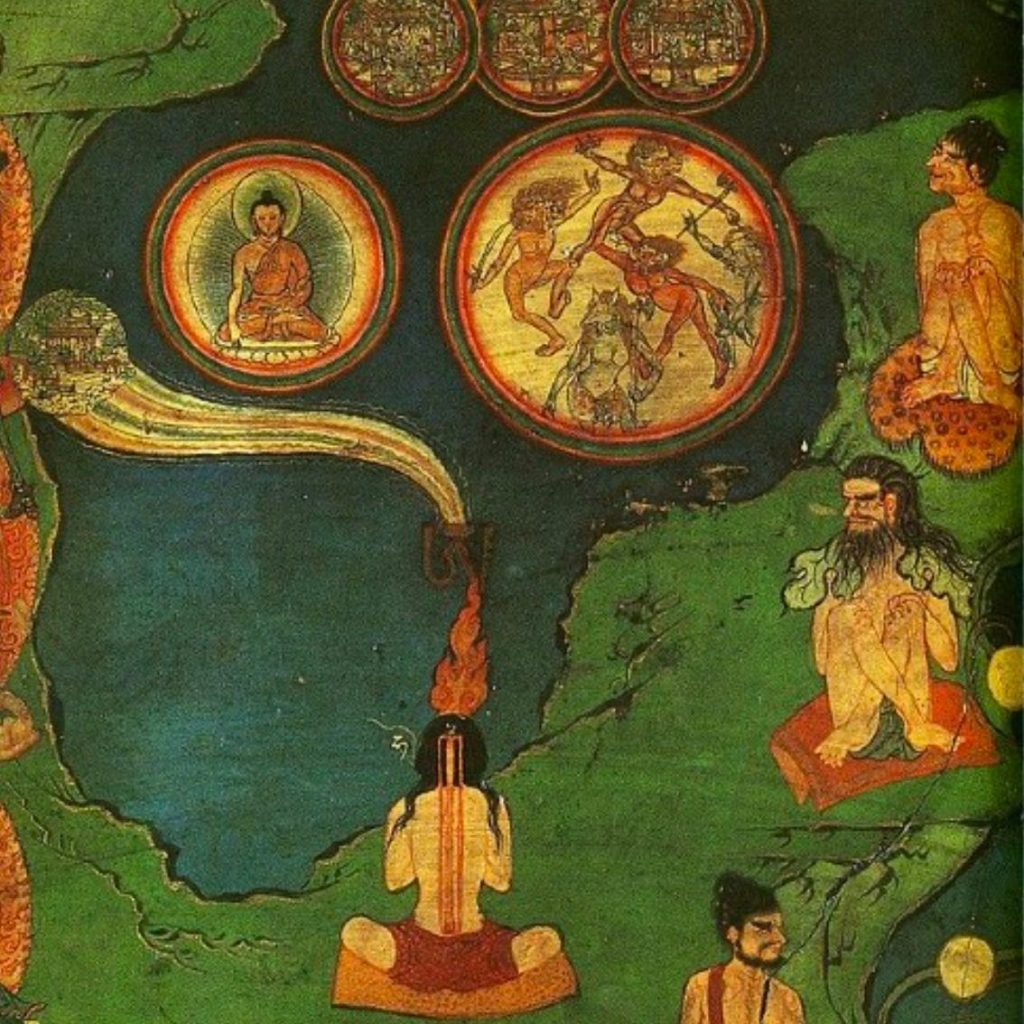
 Patanjali's yoga sutras
Leave a comment